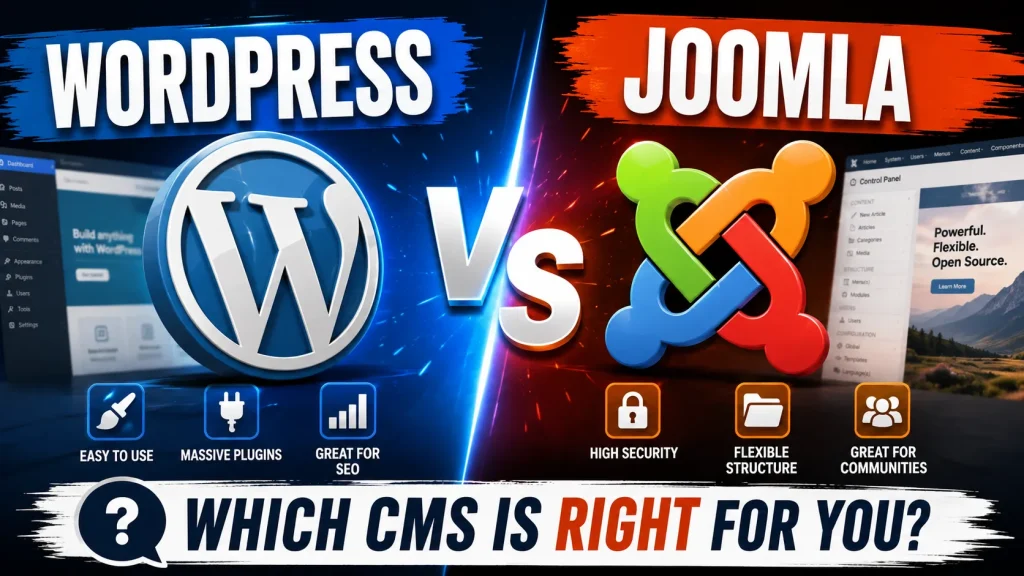
WordPress vs Joomla: Which CMS Is Right for You?

WordPress vs Joomla: Which CMS Is Right for You?

When choosing a content management system, WordPress and Joomla are two of the most established names in the industry — but they serve different audiences and excel in different scenarios. This article compares them in terms of ease of use, flexibility, security, performance, and community support. By the end, you’ll have a clear picture of which platform best fits your project. Ease of Use WordPress is widely regarded as the most beginner-friendly CMS available today. Its dashboard is clean and intuitive, letting new users publish content within minutes of installation. The learning curve is gentle enough that non-technical users — bloggers, small business owners, and content creators — can manage their sites independently. Joomla sits in a middle ground between WordPress’s simplicity and Drupal’s complexity. It offers more built-in functionality out of the box, but that power comes with a steeper initial learning curve. Users typically need more time to understand concepts like articles, categories, menu structures, and access control levels before feeling comfortable. For first-time website builders or teams without a dedicated developer, WordPress is the stronger choice. Joomla rewards users who invest time in learning its structure, but it can feel overwhelming at first. If ease of onboarding is a top priority, WordPress clearly wins this round. Flexibility and Customization WordPress has an enormous ecosystem of themes and plugins — over 60,000 plugins in the official repository alone. Almost any feature imaginable, from e-commerce to booking systems to membership portals, can be added with a few clicks. This makes WordPress extremely adaptable for a wide range of website types. Joomla also supports extensions and templates, with a library of several thousand available options. However, its real flexibility shines at the core level, where it handles complex content structures and user roles natively without needing additional plugins. This makes it particularly well-suited for multilingual sites, community portals, and intranets. Key flexibility differences include: WordPress excels at blogs, content-heavy sites, e-commerce (via WooCommerce), and landing pages. Joomla is strong for multilingual sites, membership platforms, and enterprise directories. WordPress plugins are more abundant, but plugin conflicts can be a challenge. Joomla handles complex user permissions and access levels without extra extensions. Both support custom post types and content categorization, but Joomla’s is more granular by default. Security Security is a critical consideration for any CMS, and both platforms have had their share of vulnerabilities over the years. WordPress, due to its massive popularity, is a more frequent target for hackers, making plugin hygiene and timely updates especially important. A poorly maintained WordPress site with outdated plugins is one of the most common attack vectors on the web. Joomla has a robust built-in security framework and tends to attract fewer automated attacks simply due to its smaller market share. It also has a dedicated Security Strike Team that actively monitors and patches vulnerabilities. Features like two-factor authentication and granular user permissions are available natively, without relying on third-party plugins. Security best practices for each platform include: WordPress: use reputable plugins, keep everything updated, and add a security plugin like Wordfence or Sucuri. Joomla: enable two-factor authentication, restrict backend access by IP, and stay current with core updates. Both platforms release regular security patches, so consistent maintenance is non-negotiable for either choice. Performance Out of the box, both WordPress and Joomla deliver comparable performance for standard websites. However, WordPress sites can slow down significantly when too many plugins are installed, as each adds additional database queries and HTTP requests. Choosing lightweight themes and a good caching plugin is essential for keeping WordPress fast. Joomla includes built-in caching and Gzip compression options natively in its core settings. This means a default Joomla install often performs respectably without any additional optimization plugins. For high-traffic portals or complex sites, Joomla’s native caching can provide a meaningful advantage. Performance optimization highlights: WordPress benefits greatly from caching plugins like WP Rocket or W3 Total Cache. Joomla has caching built into its admin panel, reducing reliance on third-party solutions. Both platforms work well with a CDN and a fast hosting provider. WordPress is more sensitive to plugin bloat than Joomla. Community and Support WordPress boasts the largest CMS community in the world, which translates into an abundance of tutorials, forums, YouTube channels, and third-party documentation. Finding an answer to almost any WordPress problem takes seconds with a simple web search. There is also a massive pool of WordPress developers available for hire at every budget level. Joomla has a loyal and experienced community, but it is considerably smaller than WordPress’s. The official Joomla documentation is thorough, and the forums are active, but niche questions may take longer to answer. Finding specialized Joomla developers can also be more challenging, particularly in smaller markets. Both communities offer: Active forums and official documentation sites Regular conferences and local meetup groups (WordCamps for WordPress, JoomlaDay events for Joomla) Free resources, paid courses, and community-maintained extensions Which Should You Choose? WordPress is the right choice for the vast majority of users, especially those building blogs, business sites, portfolios, or online stores. Its ease of use, enormous plugin ecosystem, and unmatched community support make it the default best option for most projects. If you want to go live quickly and keep maintenance simple, WordPress delivers. Joomla is the better choice when you need complex user management, multilingual support, or a structured content architecture that goes beyond what WordPress handles natively. It rewards teams with technical capacity and a willingness to invest in learning the platform. For community portals, government sites, or enterprise directories, Joomla’s built-in capabilities can reduce the need for layered plugin solutions. Ultimately, neither CMS is universally superior — the best choice depends entirely on your project’s specific requirements, your team’s technical skill level, and your long-term maintenance plan. Evaluating both platforms against your actual use case will always yield a better decision than following trends alone. Click here to find out more about our web development services for WordPress and Joomla. FAQ: WordPress vs Joomla

WordPress vs Joomla: Which CMS Is Right for You? Read More »
, , ,
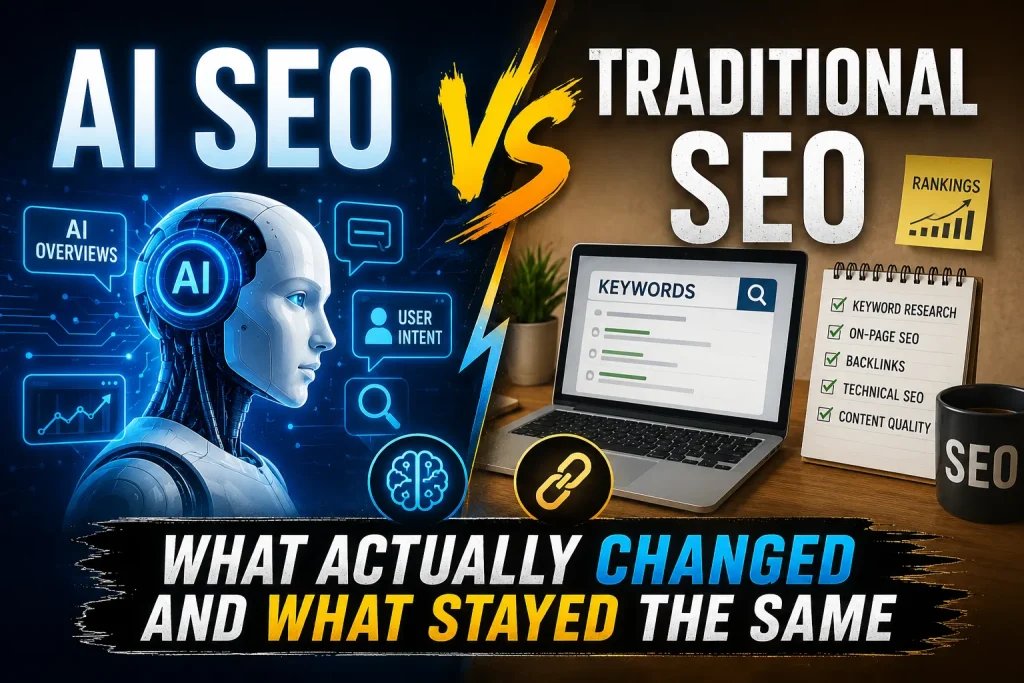
AI SEO vs Traditional SEO: What Actually Changed and What Stayed the Same

AI SEO vs Traditional SEO: What Actually Changed and What Stayed the Same

Search engine optimization has undergone a fundamental shift as artificial intelligence becomes the engine behind how search results are generated, ranked, and delivered to users. This post compares AI SEO and traditional SEO — examining which principles have been made obsolete, which have been amplified, and which entirely new practices have emerged in the AI era. Whether you are an experienced SEO professional or just building your first content strategy, understanding this shift is critical to staying visible in today’s search landscape. How Search Engines Have Changed Traditional SEO was built around a relatively predictable system — search engines crawled pages, indexed content, matched keywords to queries, and returned a ranked list of links. Google’s algorithm evolved over the years with updates like Panda, Penguin, and Hummingbird, but the fundamental output was always the same: a page of ten blue links. Marketers learned to reverse-engineer that system through keyword targeting, link building, and technical optimization. AI-powered search has changed the output fundamentally. Platforms like Google’s AI Overviews, ChatGPT Search, and Perplexity now generate synthesized answers directly on the search results page, pulling from multiple sources rather than simply listing them. The user no longer has to click through to a website to get an answer — and that shift has profound implications for how SEO success is defined and measured. The rise of large language models (LLMs) as the backbone of search means that search engines now understand context, intent, and relationships between concepts far more deeply than they ever did with keyword matching alone. A query like “what should I eat if I have high blood pressure” is no longer matched to pages containing those exact words — it is interpreted, contextualized, and answered with synthesized information from authoritative sources. This is the core change that separates AI SEO from everything that came before it. What Has Changed: The New Rules of AI SEO The most significant change in the AI era is the shift from keyword optimization to topical authority and semantic relevance. Traditional SEO rewarded pages that targeted specific keywords with precision; AI SEO rewards websites that demonstrate comprehensive, trustworthy coverage of an entire subject area. A site that publishes thirty interconnected articles on a topic is now more likely to be cited by an AI system than one that publishes a single highly optimized page targeting a competitive keyword. The measurement of SEO success has also changed in meaningful ways. Traditional SEO tracked rankings, organic clicks, and impressions — metrics that are still relevant but no longer tell the complete story. AI SEO introduces new success indicators like brand citations in AI-generated answers, share of voice in zero-click experiences, and the frequency with which your content is used as a source by LLMs. Key changes from traditional SEO to AI SEO: Keyword targeting is replaced by intent mapping and topical cluster strategy. Backlink quantity matters less; content authority and citation worthiness matter more. Exact-match keyword density is obsolete; natural language and semantic depth are rewarded. Ranking position #1 is no longer the only goal — being cited in an AI Overview or answer engine is equally valuable. Click-through rate as a primary metric is giving way to brand visibility and AI citation tracking. Page-level optimization is evolving into site-wide topical authority building. Short, keyword-stuffed content is penalized; comprehensive, well-structured answers are favored. What Has Stayed the Same: Timeless SEO Fundamentals Despite the dramatic changes in how search engines work, many of the core principles of good SEO remain as relevant as ever. High-quality, accurate, and genuinely useful content has always been rewarded by search engines, and AI systems are simply better at identifying and surfacing it than their predecessors were. The sites that invested in real expertise and trustworthy content over the years have largely weathered every algorithm shift — and that pattern continues in the AI era. Technical SEO fundamentals — site speed, mobile responsiveness, crawlability, and clean site architecture — remain essential prerequisites for visibility in both traditional and AI-powered search. An AI system cannot cite content it cannot access, and a slow or poorly structured site still signals low quality regardless of the sophistication of the ranking algorithm. Maintaining a technically sound website is as non-negotiable today as it was a decade ago. Principles that have not changed: Content quality — accurate, well-researched, and genuinely helpful content has always won. E-E-A-T (Experience, Expertise, Authoritativeness, Trustworthiness) — now more important than ever. Page speed and Core Web Vitals — performance signals remain a ranking factor. Mobile optimization — a non-negotiable requirement across all search platforms. Internal linking — still critical for helping search engines understand site structure and content relationships. Backlinks from authoritative sources — quality links still signal credibility and trust. User experience — low bounce rates, clear navigation, and accessible content remain positive signals. Structured data and schema — always useful for context; now critical for AI content extraction. Content Strategy: Then vs Now Traditional SEO content strategy was largely driven by keyword research — find a term with decent search volume and manageable competition, write an optimized page targeting that term, and build links to it. This approach produced an enormous volume of thin, repetitive content across the web as publishers chased rankings for individual queries. For a long time, it worked — and some of those tactics still produce results in traditional search today. AI SEO content strategy starts from a fundamentally different question: not “what keyword should I rank for?” but “what questions does my audience have, and how can I become the most authoritative and trustworthy source of answers on this entire subject?” This shift pushes content teams toward building interconnected topic clusters, investing in original research, incorporating expert voices, and writing with genuine depth rather than optimized superficiality. The content that AI systems extract and cite tends to be specific, factual, well-organized, and clearly attributed to a credible source. The practical difference in content approach looks like this: Traditional: write one page targeting “best project management

AI SEO vs Traditional SEO: What Actually Changed and What Stayed the Same Read More »

,
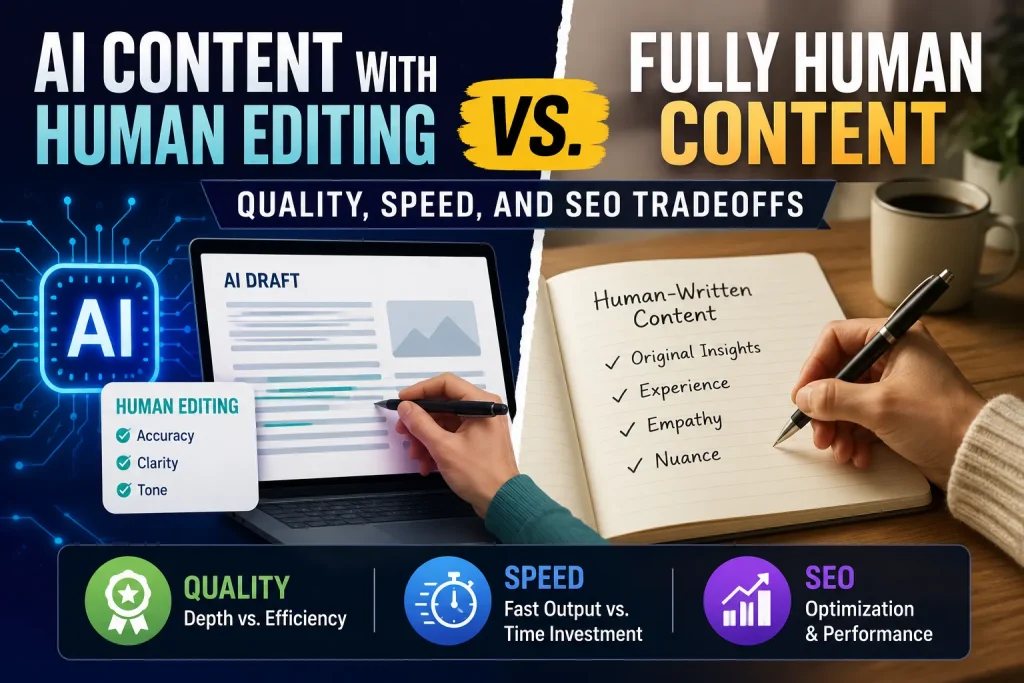
AI Content With Human Editing vs. Fully Human Content: Quality, Speed, and SEO Tradeoffs

AI Content With Human Editing vs. Fully Human Content: Quality, Speed, and SEO Tradeoffs

In 2026, the real debate isn’t AI content versus human writing; it’s AI-assisted, human-edited content versus fully human content, since unedited AI output already ranks as the weakest option in most studies. AI-assisted workflows dramatically cut production time and reduce costs several times over compared to fully manual writing, while still retaining most of the SEO performance of human-written content. Fully human content keeps a clear advantage in areas that demand lived experience, regulatory precision, or brand-defining creativity, but a well-edited AI draft can come close to matching human-level rankings in many other categories. The sections below break down how the two approaches compare on speed, quality, and SEO outcomes so you can match the right approach to the right content. The Speed and Cost Difference Is Real AI-assisted workflows can accelerate content production by more than 90% in some studies, with cost savings running several times cheaper at scale compared to fully manual production. This speed comes from AI generating first drafts, structure, and initial research synthesis in minutes, work that would otherwise take a human writer hours to complete. For teams under tight budgets or aggressive publishing schedules, this efficiency gap can determine whether an ambitious content calendar is realistic at all. That said, speed alone doesn’t guarantee quality unless human oversight is layered on top. A few consistent patterns emerge from the data: AI-assisted workflows let teams scale content output without a matching increase in headcount Time saved through AI drafting is often redirected into research, fact-checking, and original data collection instead of being cut altogether Teams that use AI solely to cut costs without adding editorial time tend to see quality erode over time Hybrid workflows that keep strategy and final editing in human hands capture most of the speed gains with less quality tradeoff Where Fully Human Content Still Wins Fully human content remains the stronger choice where lived experience, nuance, and accountability carry the most weight, including interview-driven journalism, regulated fields like legal, medical, or financial writing, and content that hinges on cultural sensitivity or tone. Human writers bring direct, firsthand experience that AI simply can’t replicate, and research shows original data or firsthand insight shows up far more often in human-written pieces than in AI-only content. This gap aligns closely with Google’s E-E-A-T standards, which reward demonstrated expertise and trustworthiness. Fully human content tends to perform best when: The subject calls for firsthand experience, such as product testing or professional case studies The industry carries regulatory or liability exposure, like medical, legal, or financial content Brand voice, humor, or cultural nuance plays a central role in how the piece connects with readers The piece is meant to serve as a flagship or brand-defining asset rather than routine content Where AI-Assisted, Human-Edited Content Holds Its Own For much of the commodity and informational content published today, AI-drafted work that’s been thoroughly edited by a knowledgeable person closes most of the performance gap with fully human writing. Several 2026 studies found AI-drafted, human-edited pieces performing within a few percentage points of fully human content, and in some cases even outperforming both extremes on organic traffic. This works because AI excels at producing clean structure and scannable formatting that search engines can parse easily, while human editing adds the accuracy and expertise signals that structure alone can’t deliver. AI-assisted, human-edited content tends to perform well for: Structured, format-driven content such as comparison posts, how-to guides, and FAQ pages High-volume topic coverage where a consistent publishing cadence matters as much as any single article Content refreshes and updates, where AI quickly incorporates new information that a human then verifies Teams that already have in-house subject-matter expertise to guide and validate AI-generated drafts What Actually Determines the Quality Gap The deciding factor across the research isn’t which tool wrote the first draft; it’s how much real human judgment goes into the piece before it’s published. Raw, unedited AI content shows a measurable and often growing SEO disadvantage, particularly for competitive keywords, while that same draft, reworked substantially by an expert, can perform close to human-level. In other words, the real decision teams face isn’t “AI or human,” but how much editorial investment to add on top of whichever starting point they use. Markers that separate strong hybrid content from weak AI-only content include: A visible, credible author with genuine expertise and a complete bio, rather than an anonymous or generic byline Original data, first-hand examples, or expert quotes woven in during editing instead of left as a generic AI summary Every factual claim, statistic, or date is verified against a credible source Brand voice and tone deliberately reviewed rather than accepted as AI’s default output A visible history of updates over time, since regularly refreshed content tends to hold rankings longer than content published once and forgotten Making the Tradeoff Decision Choosing the right approach usually comes down to matching content type to risk and reward, rather than applying one method across everything a brand publishes. Routine, lower-risk content like blog coverage or FAQ pages is often well-suited to AI-assisted, human-edited workflows given the speed and cost benefits. Flagship pieces, regulated topics, or content meant to build thought leadership generally justify the added time and cost of a fully human approach. A simple way to sort content by approach: Use AI-assisted, human-edited workflows for: routine guides, comparison content, FAQ pages, and content refreshes Reserve fully human writing for: regulated industry topics, flagship thought-leadership pieces, and anything requiring firsthand experience or interviews Apply human review to 100% of published content regardless of category, since even lightly-assisted AI drafts benefit from a final expert pass Track performance by content type over time to see where the hybrid approach holds up and where it falls short The Bottom Line AI-assisted, human-edited content and fully human content aren’t competing choices so much as two points on the same spectrum, with placement depending on a topic’s stakes and the expertise it demands. AI-assisted workflows offer real, significant speed and cost advantages, but

AI Content With Human Editing vs. Fully Human Content: Quality, Speed, and SEO Tradeoffs Read More »

, ,