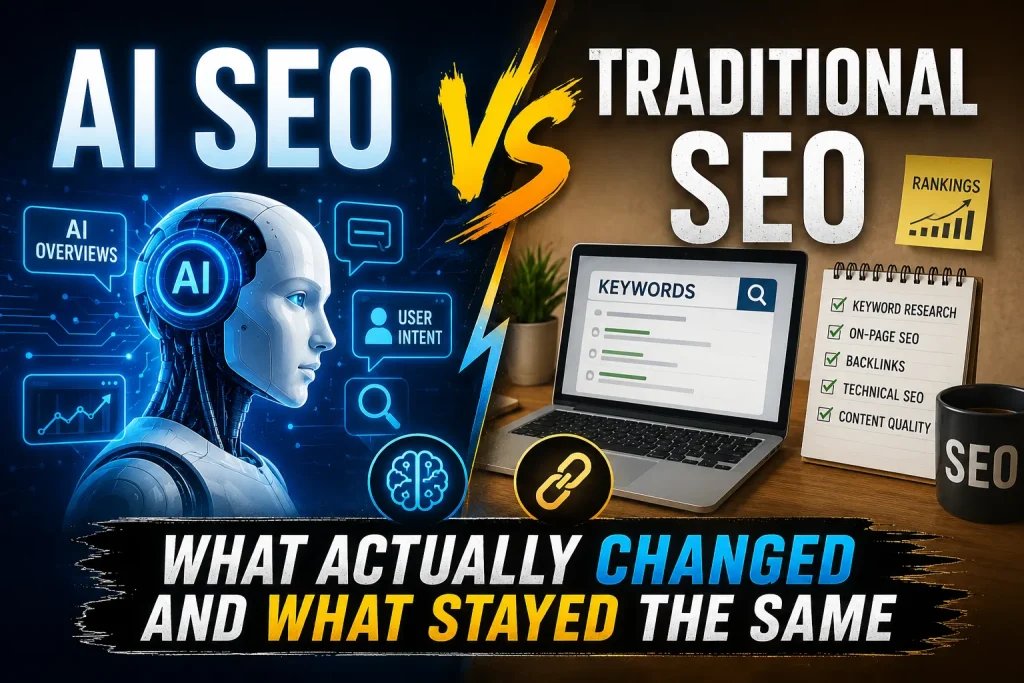
Search engine optimization has undergone a fundamental shift as artificial intelligence becomes the engine behind how search results are generated, ranked, and delivered to users. This post compares AI SEO and traditional SEO — examining which principles have been made obsolete, which have been amplified, and which entirely new practices have emerged in the AI era. Whether you are an experienced SEO professional or just building your first content strategy, understanding this shift is critical to staying visible in today’s search landscape.
How Search Engines Have Changed
Traditional SEO was built around a relatively predictable system — search engines crawled pages, indexed content, matched keywords to queries, and returned a ranked list of links. Google’s algorithm evolved over the years with updates like Panda, Penguin, and Hummingbird, but the fundamental output was always the same: a page of ten blue links. Marketers learned to reverse-engineer that system through keyword targeting, link building, and technical optimization.
AI-powered search has changed the output fundamentally. Platforms like Google’s AI Overviews, ChatGPT Search, and Perplexity now generate synthesized answers directly on the search results page, pulling from multiple sources rather than simply listing them. The user no longer has to click through to a website to get an answer — and that shift has profound implications for how SEO success is defined and measured.
The rise of large language models (LLMs) as the backbone of search means that search engines now understand context, intent, and relationships between concepts far more deeply than they ever did with keyword matching alone. A query like “what should I eat if I have high blood pressure” is no longer matched to pages containing those exact words — it is interpreted, contextualized, and answered with synthesized information from authoritative sources. This is the core change that separates AI SEO from everything that came before it.
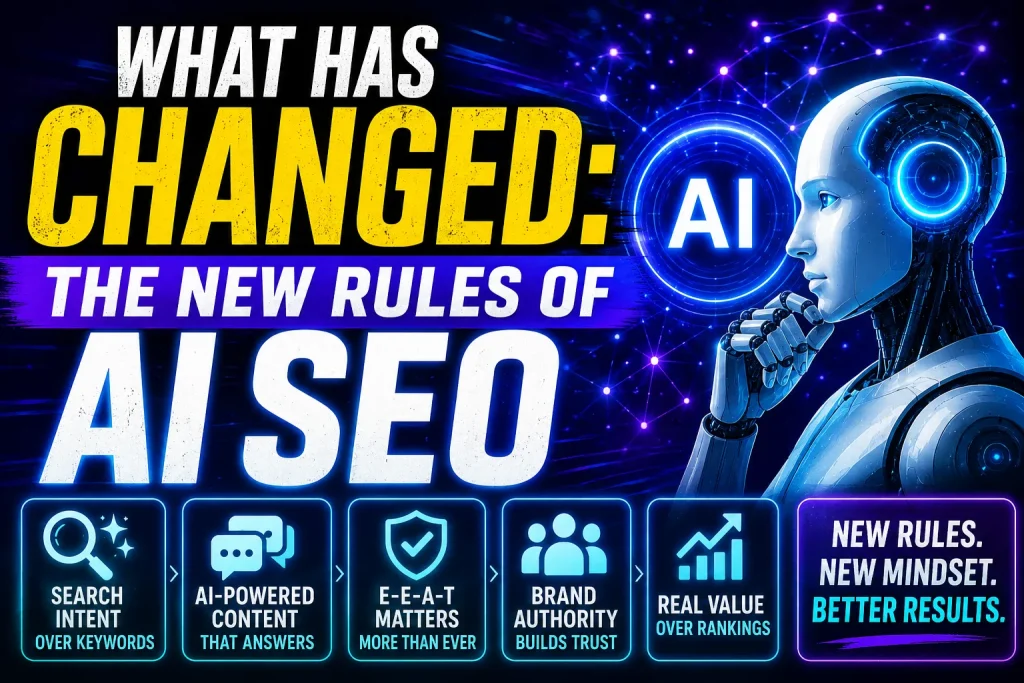
What Has Changed: The New Rules of AI SEO
The most significant change in the AI era is the shift from keyword optimization to topical authority and semantic relevance. Traditional SEO rewarded pages that targeted specific keywords with precision; AI SEO rewards websites that demonstrate comprehensive, trustworthy coverage of an entire subject area. A site that publishes thirty interconnected articles on a topic is now more likely to be cited by an AI system than one that publishes a single highly optimized page targeting a competitive keyword.
The measurement of SEO success has also changed in meaningful ways. Traditional SEO tracked rankings, organic clicks, and impressions — metrics that are still relevant but no longer tell the complete story. AI SEO introduces new success indicators like brand citations in AI-generated answers, share of voice in zero-click experiences, and the frequency with which your content is used as a source by LLMs.
Key changes from traditional SEO to AI SEO:
- Keyword targeting is replaced by intent mapping and topical cluster strategy.
- Backlink quantity matters less; content authority and citation worthiness matter more.
- Exact-match keyword density is obsolete; natural language and semantic depth are rewarded.
- Ranking position #1 is no longer the only goal — being cited in an AI Overview or answer engine is equally valuable.
- Click-through rate as a primary metric is giving way to brand visibility and AI citation tracking.
- Page-level optimization is evolving into site-wide topical authority building.
- Short, keyword-stuffed content is penalized; comprehensive, well-structured answers are favored.
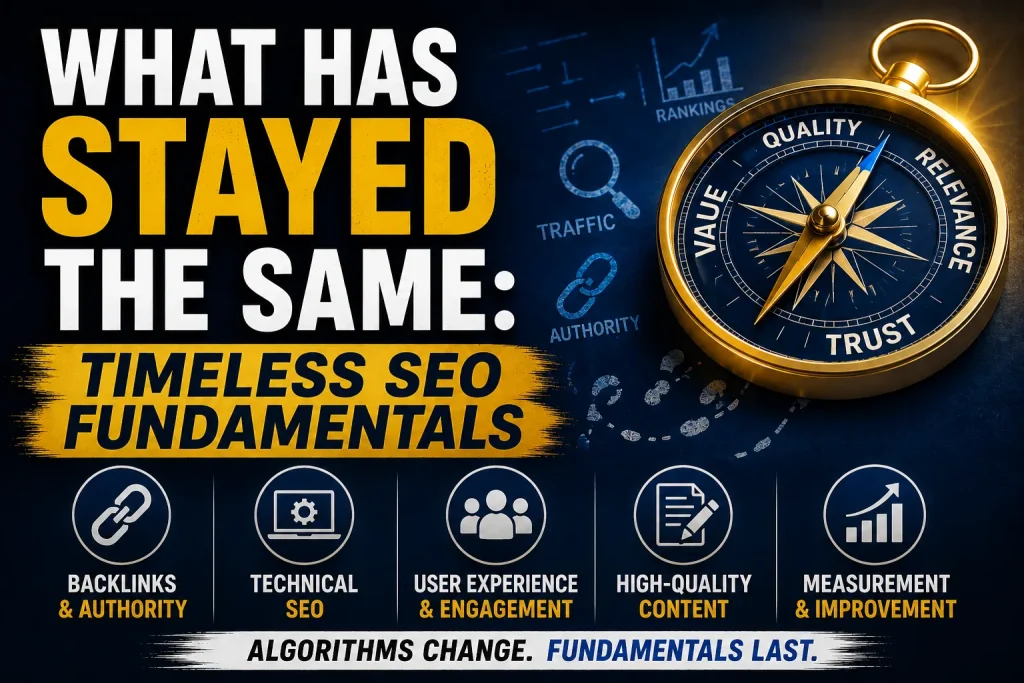
What Has Stayed the Same: Timeless SEO Fundamentals
Despite the dramatic changes in how search engines work, many of the core principles of good SEO remain as relevant as ever. High-quality, accurate, and genuinely useful content has always been rewarded by search engines, and AI systems are simply better at identifying and surfacing it than their predecessors were. The sites that invested in real expertise and trustworthy content over the years have largely weathered every algorithm shift — and that pattern continues in the AI era.
Technical SEO fundamentals — site speed, mobile responsiveness, crawlability, and clean site architecture — remain essential prerequisites for visibility in both traditional and AI-powered search. An AI system cannot cite content it cannot access, and a slow or poorly structured site still signals low quality regardless of the sophistication of the ranking algorithm. Maintaining a technically sound website is as non-negotiable today as it was a decade ago.
Principles that have not changed:
- Content quality — accurate, well-researched, and genuinely helpful content has always won.
- E-E-A-T (Experience, Expertise, Authoritativeness, Trustworthiness) — now more important than ever.
- Page speed and Core Web Vitals — performance signals remain a ranking factor.
- Mobile optimization — a non-negotiable requirement across all search platforms.
- Internal linking — still critical for helping search engines understand site structure and content relationships.
- Backlinks from authoritative sources — quality links still signal credibility and trust.
- User experience — low bounce rates, clear navigation, and accessible content remain positive signals.
- Structured data and schema — always useful for context; now critical for AI content extraction.
Content Strategy: Then vs Now
Traditional SEO content strategy was largely driven by keyword research — find a term with decent search volume and manageable competition, write an optimized page targeting that term, and build links to it. This approach produced an enormous volume of thin, repetitive content across the web as publishers chased rankings for individual queries. For a long time, it worked — and some of those tactics still produce results in traditional search today.
AI SEO content strategy starts from a fundamentally different question: not “what keyword should I rank for?” but “what questions does my audience have, and how can I become the most authoritative and trustworthy source of answers on this entire subject?” This shift pushes content teams toward building interconnected topic clusters, investing in original research, incorporating expert voices, and writing with genuine depth rather than optimized superficiality. The content that AI systems extract and cite tends to be specific, factual, well-organized, and clearly attributed to a credible source.
The practical difference in content approach looks like this:
- Traditional: write one page targeting “best project management software,” optimize for that keyword.
- AI SEO: build a content hub covering project management comprehensively — tools, methodologies, team structures, templates, case studies — so AI systems recognize your site as an authority on the topic.
- Traditional: 1,000-word articles targeting individual long-tail keywords.
- AI SEO: comprehensive pillar pages with supporting cluster content that answers every related question.
- Traditional: update content reactively when rankings drop.
- AI SEO: maintain content freshness proactively, as AI systems favor recently verified and updated information.
Link Building: Evolving but Not Dead
Link building has been a cornerstone of SEO since Google’s original PageRank algorithm, and it remains a meaningful signal in AI-era search. However, the nature of valuable links has shifted — AI systems are trained on vast datasets of web content, and links from highly authoritative, topically relevant sources carry more weight than ever, while links from low-quality directories or irrelevant sites have become essentially worthless. Quality over quantity has never been more applicable than it is today.
A new dimension of link building in the AI era is earning citations within AI-generated content itself. When an AI system like Perplexity or ChatGPT cites your website as a source in a generated answer, it functions as a form of digital authority — even if no traditional hyperlink passes PageRank. Building the kind of content that LLMs want to reference (clear, factual, well-attributed, from a recognized authority) has become an important extension of the traditional link-building mindset.
How link building has evolved:
- Traditional: The volume of backlinks was a primary ranking signal.
- AI SEO: quality, relevance, and authority of linking domains matter far more than quantity.
- New priority: earning citations in AI-generated answers as a form of visibility beyond traditional links.
- Digital PR — getting mentioned by reputable publications and institutions — now serves double duty as both a link-building and AI citation strategy.
- Toxic link disavowal remains important; AI systems trained on web data may reflect the authority signals embedded in that data.
Keyword Research: Transformed, Not Eliminated
Keyword research has not disappeared in the AI era, but its purpose and methodology have changed significantly. Traditional keyword research focused on finding terms with specific search volumes and competition scores, then mapping individual pages to those terms. AI SEO keyword research focuses more on understanding the full landscape of questions, intents, and subtopics within a subject area — and then building content that addresses that landscape comprehensively rather than targeting each term in isolation.
Conversational and question-based queries have become more important as users interact with AI search in a more natural, dialogue-like way. Phrases like “how do I,” “what is the best way to,” and “can you explain” are increasingly common entry points into AI search experiences, and content that mirrors this conversational structure is more likely to be surfaced. Long-tail, intent-rich queries are now more valuable than ever — not as individual targets, but as signals that help you understand what your audience actually needs.
Keyword research in the AI era looks like:
- Mapping intent clusters rather than individual keywords to content pages.
- Prioritizing question-based queries that match how users speak to AI search tools.
- Using tools to find semantic relationships.
- Identifying featured snippet and AI Overview opportunities — queries where structured answers are already appearing.
- Tracking brand visibility in AI-generated responses alongside traditional rank tracking.
Measuring Success: Old Metrics vs New Metrics
Traditional SEO measurement was built around a clear set of metrics: keyword rankings, organic traffic, click-through rate, bounce rate, and conversions. These metrics were reliable proxies for visibility and business impact because the primary path from search to website was a click. Google Search Console and third-party rank trackers gave SEO teams a reasonably complete picture of how they were performing.
AI SEO requires an expanded measurement framework that accounts for visibility beyond the click. A brand can be cited in thousands of AI-generated answers per day and receive significant brand awareness value without a single click being recorded in Google Search Console. New tools and methodologies — including prompt testing, AI citation monitoring, and share-of-voice tracking across answer engines — are emerging to fill this measurement gap, though the discipline is still maturing.
Metrics comparison — old vs new:
- Traditional: keyword ranking position → AI SEO: AI citation frequency and share of voice.
- Traditional: organic click-through rate → AI SEO: zero-click brand visibility.
- Traditional: page-level traffic → AI SEO: topical authority score across a content cluster.
- Traditional: backlink count → AI SEO: citation quality and LLM source recognition.
- Traditional: Google Search Console impressions → AI SEO: presence in AI Overviews and answer engine responses.
- Both eras share: conversion rate, time on page, and revenue from organic traffic as bottom-line indicators.
Which Approach Should You Follow in 2026?
The most effective SEO strategy in 2026 is not a choice between traditional SEO and AI SEO — it is a deliberate integration of both. Traditional SEO fundamentals like technical health, quality content, and authoritative backlinks remain the foundation on which AI SEO visibility is built. Abandoning proven practices in favor of chasing the latest AI optimization trend is as misguided as ignoring AI search entirely and hoping traditional tactics will be enough.
The practical recommendation for most websites is to audit your existing content strategy against AI SEO principles and identify the gaps. If your content is thin, keyword-stuffed, or lacks genuine depth and authority, no amount of schema markup or prompt optimization will make AI systems want to cite it. Fix the foundation first — then layer in AI-specific optimizations like structured data, topical cluster architecture, and answer-engine visibility monitoring.
A combined action plan for 2026:
- Audit existing content for depth, accuracy, and E-E-A-T signals — update or consolidate thin pages.
- Build topical clusters around your core subject areas rather than targeting isolated keywords.
- Implement structured data (FAQ, HowTo, Article schema) to help AI systems extract your content.
- Monitor AI visibility using prompt testing and emerging citation tracking tools.
- Invest in digital PR to earn mentions from authoritative sources that both traditional search and AI systems recognize.
- Keep technical SEO clean — fast pages, solid architecture, and proper indexation are table stakes for both eras.
- Measure both old and new metrics to get a complete picture of your organic visibility across traditional and AI-powered search.
FAQ: AI SEO vs Traditional SEO — What Actually Changed and What Stayed the Same
What is the core difference between AI SEO and traditional SEO?
Traditional SEO was built around helping search engines match keyword-optimized pages to user queries and return a ranked list of links. AI SEO is the practice of optimizing content to be surfaced, cited, or referenced by AI-powered search systems like Google's AI Overviews, ChatGPT Search, and Perplexity — which generate synthesized answers rather than simply listing links. The fundamental shift is from ranking in a list to being selected as a trusted source inside an AI-generated response.
Is traditional SEO dead now that AI search has taken over?
No — traditional SEO is not dead, and the fundamentals that have always driven success remain highly relevant. Quality content, authoritative backlinks, technical site health, and strong user experience are still essential prerequisites for visibility in both traditional and AI-powered search. The most effective approach in 2026 is a deliberate integration of both, not an either/or choice.
What has actually changed from traditional SEO to AI SEO?
The biggest changes include the shift from keyword targeting to topical authority, from page-level optimization to site-wide subject matter expertise, and from tracking rankings to tracking AI citations and zero-click visibility. Exact-match keyword density is now obsolete, while natural language depth and comprehensive topic coverage are heavily rewarded. Success metrics have also expanded — it is no longer enough to track rankings and clicks when your brand can be cited in AI answers without generating a single click.
What SEO principles have stayed the same in the AI era?
Many core fundamentals remain unchanged, including the importance of high-quality and accurate content, E-E-A-T signals (Experience, Expertise, Authoritativeness, and Trustworthiness), page speed, mobile optimization, internal linking, and backlinks from authoritative sources. AI systems are simply better than previous algorithms at identifying and rewarding genuinely useful content — so the sites that always prioritized quality have largely continued to perform well. Structured data and schema markup, always useful for context, have become even more critical now that AI systems use them to extract and understand content.
How has content strategy changed for AI SEO?
Traditional content strategy asked "what keyword should I rank for?" and produced individual optimized pages for each target term. AI SEO content strategy asks "how can I become the most authoritative and trustworthy source on this entire subject?" and builds interconnected topic clusters, pillar pages, and comprehensive content hubs that cover every related question. AI systems favor content that is specific, factual, well-organized, and clearly attributed to a credible source — not content designed to hit a keyword density target.
Is keyword research still relevant in the AI era?
Yes, keyword research is still relevant, but its purpose has shifted significantly. Rather than mapping individual keywords to individual pages, AI SEO keyword research focuses on understanding the full landscape of questions and intents within a subject area, then building content that addresses that landscape comprehensively. Conversational and question-based queries have also become more important, as users increasingly interact with AI search in a natural, dialogue-like way.
How has link building changed with AI SEO?
Link building remains a meaningful signal, but the emphasis has firmly shifted from volume to quality and topical relevance. Links from highly authoritative, contextually relevant sources carry more weight than ever, while links from low-quality directories or irrelevant sites have become essentially worthless. A new dimension has also emerged — earning citations within AI-generated answers themselves, which functions as a form of digital authority even when no traditional hyperlink is involved.
What new metrics do I need to track for AI SEO?
AI SEO requires expanding your measurement framework beyond traditional metrics like keyword rankings, organic traffic, and click-through rate. New indicators include AI citation frequency (how often your content is referenced in AI-generated answers), share of voice across answer engines, and brand visibility in zero-click search experiences. Tools and methodologies for tracking these metrics — including prompt testing and AI citation monitoring — are still maturing, but monitoring them alongside traditional metrics gives the most complete picture of your organic visibility.
How do I get my content cited by AI search systems like Perplexity or ChatGPT?
AI systems tend to cite content that is clear, factual, well-structured, directly answers specific questions, and comes from a recognized authority. Implementing structured data like FAQ, HowTo, and Article schema helps AI systems extract and contextualize your content more accurately. Building topical authority through interconnected content clusters, investing in original research, and earning mentions from reputable publications all increase the likelihood that AI systems will select your site as a trusted source.
Do I need to choose between traditional SEO and AI SEO?
No — you should not choose between them, and trying to do so would leave significant visibility on the table. Traditional SEO fundamentals are the foundation on which AI SEO visibility is built, and abandoning proven practices in favor of chasing AI optimization trends is just as risky as ignoring AI search entirely. The practical approach is to audit your existing content against AI SEO principles, fix any gaps in quality and authority, and then layer in AI-specific strategies like topical clustering, structured data, and answer-engine monitoring.
Where should I start if I want to adapt my SEO strategy for the AI era?
Start by auditing your existing content for depth, accuracy, and E-E-A-T signals — thin or keyword-stuffed content will not be cited by AI systems regardless of how well it was optimized for traditional search. From there, build topical clusters around your core subject areas, implement structured data, and begin monitoring your brand's presence in AI-generated answers. Keep your technical SEO clean throughout, and measure both traditional and new AI-era metrics to get a complete view of how your organic visibility is evolving.